Iris and Morpheus
at the Grand Trianon in the Park of the Palace of Versailles
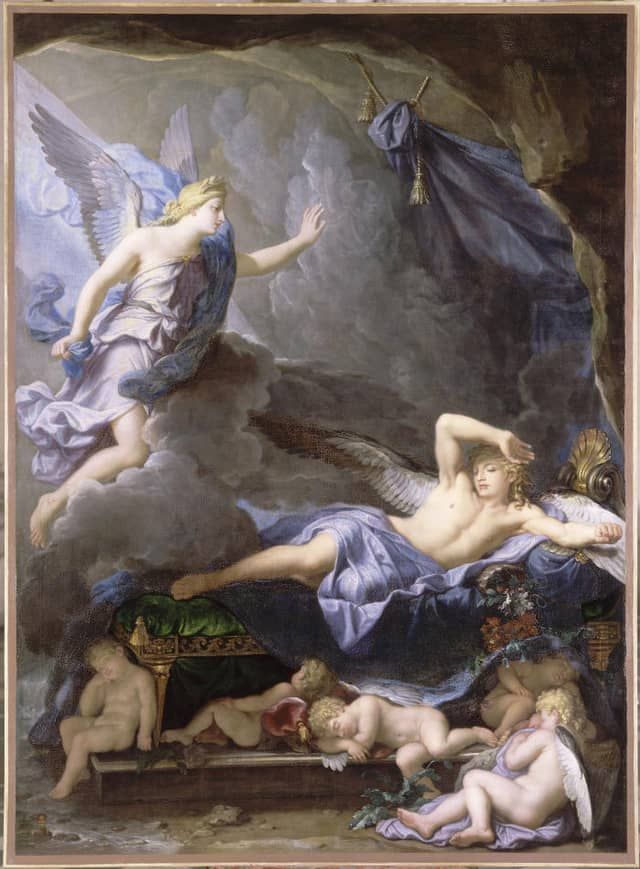
“and instantly, that sacred cavern of the god of Sleep was all illuminated with the glow and splendor of her garment”, The Metamorphoses, Book XI, verse 616.
In the Salon de Famille de Louis-Philippe of the Grand Trianon (opens in a new tab) in Versailles a painting from René-Antoine Houasse (opens in a new tab), Morpheus awakening as Iris draws near (also Iris and Morpheus) can be seen.
Based on a part of Book XI of The Metamorphoses (opens in a new tab) written by Ovid (opens in a new tab), it represents the particular moment when Iris (opens in a new tab), messager of Juno (opens in a new tab) enters the cave of the Sleep (opens in a new tab) to order to him to make Alcynoe (opens in a new tab) dream.
Iris according to text of Book XI of The Metamorphoses
583 but Juno could not long accept as hers
these supplications on behalf of one
then dead; and that she might persuade Halcyone
to turn her death-polluted hands away
“O, Iris, best of all my messengers,
go quickly to the dreadful court of Sleep,
and in my name command him to despatch
a dream in the shape of Ceyx, who is dead,
and tell Halcyone the woeful truth.”
So she commanded.—Iris instantly
assumed a garment of a thousand tints;
and as she marked the high skies with her arch,
went swiftly thence as ordered, to the place
where Sleep was then concealed beneath a rock.
Near the Cimmerian Land there is a cave,
with a long entrance, in a hallowed mountain,
the home of slothful Sleep. To that dark cave
the Sun, when rising or in middle skies,
or setting, never can approach with light.
There dense fogs, mingled with the dark, exhale
darkness from the black soil—and all that place
is shadowed in a deep mysterious gloom.
No wakeful bird with visage crested high
calls forth the morning's beauty in clear notes;
nor do the watchful dogs, more watchful geese,
600 nor wild beasts, cattle, nor the waving trees,
make sound or whisper; and the human voice
is never heard there—silent Rest is there.
But, from the bottom of a rock beneath,
Lethean waters of a stream ooze forth,
sounds of a rivulet, which trickle with
soft murmuring amid the pebbles and
invite soft sleep. Before the cavern doors
most fertile poppies and a wealth of herbs
bloom in abundance, from the juice of which
the humid night-hours gather sleep and spread
it over darkened Earth. No door is in
that cavern-home and not a hinge's noise
nor guarding porter's voice disturbs the calm.
But in the middle is a resting-couch,
raised high on night-black ebony and soft
with feathered cushions, all jet black, concealed
by a rich coverlet as dark as night,
on which the god of sleep, dissolved in sloth
lies with unmoving limbs. Around him there
in all directions, unsubstantial dreams
recline in imitation of all shapes—
as many as the uncounted ears of corn
at harvest—as the myriad leaves of trees—
or tiny sand grains spread upon the shore.
616 As soon as Iris entered that dread gloom,
she pushed aside the visions in her way
with her fair glowing hands; and instantly,
that sacred cavern of the god of Sleep
was all illuminated with the glow
and splendor of her garment.—Out of himself
the god with difficulty lifted up
his lanquid eyes. From this small sign of life
relapsing many times to languid sloth,
while nodding, with his chin he struck his breast
again and again. At last he roused himself
from gloom and slumber; and, while raised upon
his elbow, he enquired of Iris why
she came to him.—He knew her by her name.
“O, Sleep, divine repose
of all things! Gentlest of the deities!
Peace to the troubled mind, from which you drive
the cares of life, restorer of men's strength
when wearied with the toils of day, command
a vision that shall seem the actual form
of royal Ceyx to visit Trachin famed
for Hercules and tell Halcyone
his death by shipwreck. It is Juno's wish.”
630 Iris departed after this was said.
For she no longer could endure the effect
of slumber-vapor; and as soon as she
knew sleep was creeping over her tired limbs
she flew from there—and she departed by
632 the rainbow, over which she came before.